
CircularFood – Circularity and Innovation: Applying Sustainable Models in the Agri-food Supply Chain
The project “Circularity and Innovation: Applying Sustainable Models in the Agri-food Supply Chain” – “CIRCULARFOOD” is implemented under Regulation (EU) 2021/2115, the Tuscany Region’s 2023–2027 CSR and the 2024 implementing call for intervention SRG01 – Support for European Innovation Partnership Agricultural Productivity and Sustainability Operational Groups (EIP-AGRI).
The project is funded by the Tuscany Region through EAFRD funds and involves the NEUROFARBA and DiSIA Departments of the University of Florence.
Duration: 24 months, with completion scheduled by 31 December 2027.
Lead partner: APAB APS Training Institute, Florence.
Project lead for NEUROFARBA: Prof. Cristina Luceri, in collaboration with Dr Elisabetta Bigagli.
Project partners
- University of Florence – Department of Statistics, Computer Science, Applications “G. Parenti” (DiSIA), Phytolab – Pharmaceutical, Cosmetic, Food Supplement Technology and Analysis Laboratory;
- University of Florence – Department of Neuroscience, Psychology, Drug Research and Child Health (NEUROFARBA), Pharmacology and Toxicology Section;
- Bioadhoc srl, Florence;
- San Mario Farm, owned by Martina Kunzi, Bibbona (Livorno);
- “I vini di Maremma” Winery, Grosseto;
- AGRO-DENDRO STUDIO, Prato;
- Montalbano Biodistrict, Carmignano (Prato).
Project background and aims
In recent years, the valorisation of agri-food by-products has taken on a central role in European strategies concerning environmental sustainability, the circular economy and the ecological transition of production supply chains.
Numerous scientific studies have shown that waste generated by agricultural and agri-food production represents an important source of high-value bioactive compounds. At the same time, the agri-food sector is showing increasing interest in functional and natural ingredients capable of improving the nutritional quality of food and the sustainability of production processes.
However, despite growing scientific and industrial interest, many currently available applications have not yet been effectively transferred to small and medium-sized agricultural and agri-food enterprises, particularly with regard to process replicability and the economic sustainability of the proposed solutions.
CircularFood addresses this context through an innovative, multidisciplinary approach integrating organic and biodynamic farming, agri-food processing, scientific and technological expertise, and the transfer of innovation to businesses.
Main objective of the project
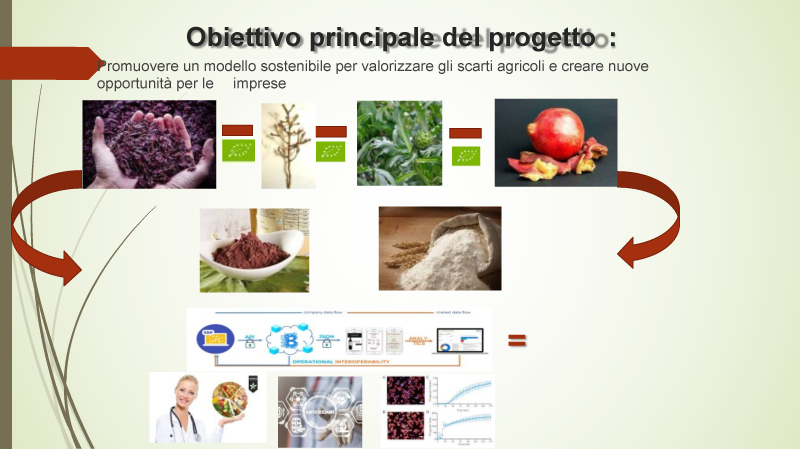
The main objective of the CircularFood project is to promote a sustainable model for the valorisation of agricultural waste, transforming it into high-value resources and creating new opportunities for businesses operating within agri-food supply chains.
CircularFood innovation
The project’s innovation consists in developing functional powders obtained through the valorisation of agricultural by-products from different production supply chains, with potential applications in both the food and agronomic sectors.
The powders developed will be characterised by:
- a high fibre content;
- the presence of polyphenolic compounds;
- antioxidant properties;
- antimicrobial and functional activity.
These ingredients may be used to:
- develop innovative ingredients with high functional value;
- test their application in prototype products;
- assess their technological, sensory and biological properties;
- evaluate their potential use as natural biostimulants and antimicrobial agents.
Technology transfer and the circular economy
The project is distinguished by its strong focus on technology transfer and the dissemination of innovation, supporting the creation of a replicable circular-economy model that can be applied to local agri-food supply chains.
CircularFood therefore helps bring together the scientific community, agricultural enterprises and the food-processing sector by transforming by-products and production residues into new, sustainable, high-value resources.
Alignment with European strategies
The project is fully aligned with the EU Biodiversity Strategy for 2030, the European strategy for protecting biodiversity and promoting more sustainable agricultural systems, as well as with the Nature Restoration Law, which aims to restore degraded ecosystems and reduce the environmental pressure generated by production activities.
Learn more about the EU Biodiversity Strategy for 2030
Objectives of intervention SRG01
The project contributes to the following general objectives established under SRG01 – Support for EIP-AGRI Operational Groups and to the specific objectives of the corresponding call for proposals:
-
General objective A – Foster a smart, resilient and diversified agricultural sector, ensuring long-term food security.
- Specific objective 4: contribute to climate-change mitigation, waste reduction and the sustainable management of natural resources by valorising agri-food waste and developing circular and sustainable production models.
-
General objective B – Strengthen market orientation and increase the competitiveness of agricultural enterprises.
- Specific objective 9: respond to public demand for healthy diets, food quality and sustainability through the development of functional ingredients and innovative products obtained by recovering agricultural by-products with high nutraceutical value.
CircularFood contributes across several specific objectives of the Common Agricultural Policy – CAP 2023–2027 by promoting sustainable and innovative production models geared towards the ecological transition of agri-food supply chains.
The One Health approach
The project also adopts the “One Health” approach, which recognises the close relationship between environmental health, the health of agricultural production systems, food safety and quality, and human well-being, promoting:
- natural and sustainable ingredients;
- reduced use of synthetic chemicals;
- the valorisation of natural bioactive compounds;
- higher quality and greater sustainability across food supply chains.
Learn more about the One Health approach
Last update
16.07.2026